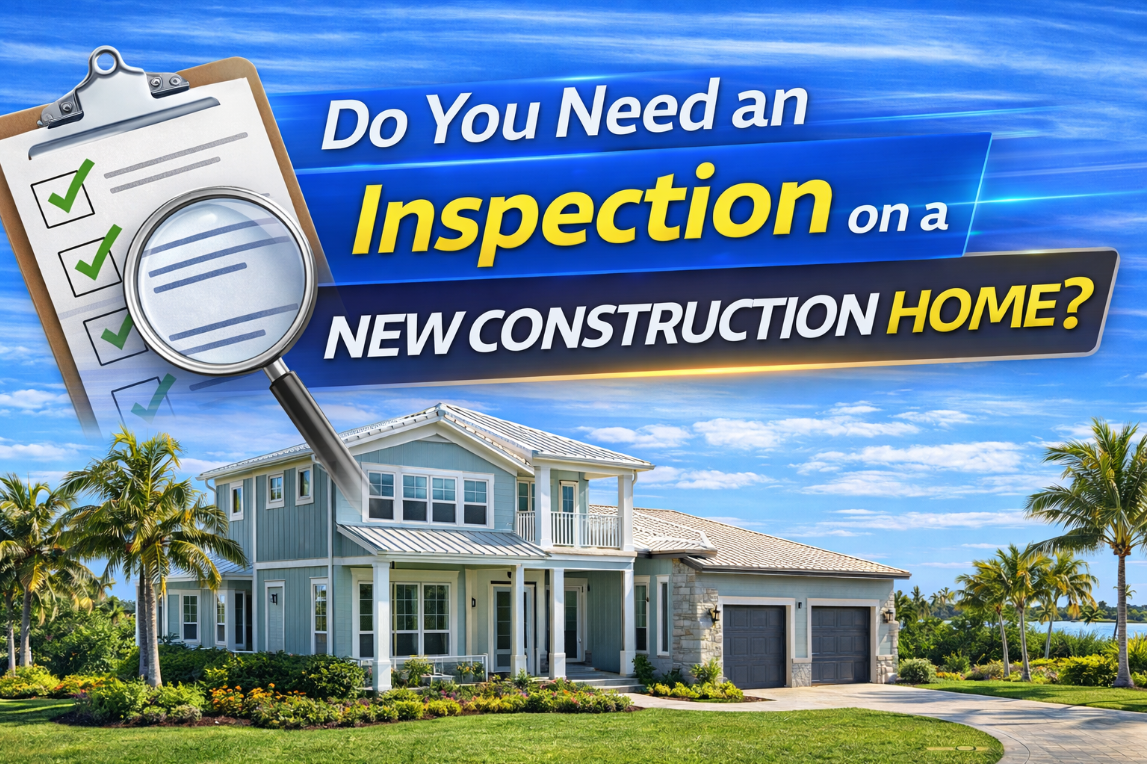
Yes, in most cases, it is smart to get an independent inspection on a new construction home in Sarasota.
That answer surprises a lot of buyers.
People often assume that because the home is brand new, built to code, and inspected by the local building department, there is no real need for a separate home inspection. But local code inspections and a private home inspection are not the same thing. Sarasota County’s Building Division handles permitting, plan review, and inspections, and the City of Sarasota says its staff provide technical inspections to make sure projects conform to codes and regulations. InterNACHI also explains that code inspections are performed by local building officials, while pre-drywall and home inspections are done by certified home inspectors.
That difference matters.
A code inspection is about compliance with the adopted code. A private home inspection is about giving the buyer an independent look at the home’s condition, workmanship, installation issues, and visible defects before closing or before warranty deadlines pass. InterNACHI states plainly that home inspections are not code inspections and that home inspectors serve as a neutral third party who provides an overall evaluation of the home’s condition.
So if you are buying new construction in Sarasota, Lakewood Ranch, Venice, Nokomis, or nearby areas, the better question is not whether the home is new. The better question is whether you want an independent set of eyes on one of the biggest purchases you will make.
Why buyers think a new home does not need an inspection
This misunderstanding is common because buyers hear that the house has “already passed inspection.”
Usually, that means the home has gone through required municipal inspections tied to the permit process. Sarasota County’s Building Division lists inspections as part of the permitting process, and the City of Sarasota says building staff review plans and provide technical inspections for code compliance. But neither source says those inspections replace a buyer’s own inspection.
That is an important distinction. Passing required inspections does not mean a home is flawless. It means the project has gone through the jurisdiction’s inspection process for code compliance.
Code inspections and private inspections are not the same
This is the biggest point buyers need to understand.
InterNACHI explains that code inspections are conducted by local building officials and that pre-drywall inspections and home inspections are conducted by certified home inspectors. It also explains that a home inspection is a comprehensive evaluation of a home’s condition, while code inspections are different in purpose and enforcement.
In plain language, local inspectors are checking for code-related items as part of the building process. A private inspector is working for you.
That private inspection can help identify visible issues such as incomplete installation, workmanship concerns, drainage problems, missing insulation details, mechanical defects, cracked tiles, improper grading, doors or windows not operating properly, HVAC issues, roofing concerns, plumbing leaks, or electrical problems that may still need correction. InterNACHI’s guidance emphasizes that home inspectors provide buyers with a fuller picture of how the house is put together and functioning.
Why an inspection still matters on a brand-new home
A new home is still a construction project completed by many different crews over many different days.
That means mistakes can happen, even in well-run communities. An independent inspection is not a statement that the builder is bad. It is a way to verify the home you are buying, the way you would verify any other major purchase. InterNACHI says home inspections are valuable even on brand-new homes and specifically notes that the home can be brand new with no one living in it yet.
This is especially worth thinking about in fast-moving new construction environments, where many homes may be built at once and closings happen on tight timelines. That does not automatically mean problems exist, but it does mean buyers benefit from an independent review before they lose leverage.
What stages of inspection buyers often consider
For new construction, buyers often think about inspections in phases rather than just one final inspection.
A common approach includes:
Pre-drywall inspection
This happens before insulation and drywall cover the framing, wiring, plumbing runs, and some mechanical work. InterNACHI specifically discusses pre-drywall inspections as an important stage because it is the chance to see issues before they get covered up.
Final inspection before closing
This is the inspection most buyers think of. It focuses on the home as delivered near closing.
Warranty inspection
Some buyers also schedule an inspection before the builder’s first-year warranty period expires so they can document issues while coverage may still apply. FTC consumer guidance says newly built homes generally come with a builder warranty, but those warranties usually offer limited coverage and vary by component and time period.
Not every buyer does all three. But many buyers consider at least a final inspection, and some add a pre-drywall and one-year warranty inspection for extra protection.
What a builder warranty does and does not do
A builder warranty is helpful, but it is not the same thing as an inspection.
The FTC says most newly built homes come with a builder warranty. Its consumer guidance also says these warranties generally offer limited coverage, often with workmanship and materials covered for specific periods and some builders offering longer coverage for certain structural defects. In the FTC’s newer consumer fact sheet, typical examples include one year for many workmanship/material items, around two years for HVAC, plumbing, and electrical in many plans, and in some cases up to 10 years for major structural defects.
That is useful, but it does not remove the value of finding issues early. A warranty helps define what may be covered after the fact. An inspection helps you identify problems before closing or before a warranty deadline runs out.
Why Sarasota buyers should care about local code and permitting anyway
Even though a private inspection is separate from a code inspection, local permitting still matters.
The City of Sarasota says projects are reviewed under the current Florida Building Code, and it notes that applications are subject to the 8th Edition 2023 Florida Building Code. Sarasota County likewise explains that its Building Division is involved in the permitting and inspection process.
That is good news because it means there is a formal building review process in place. But it still does not change the basic point: code compliance and buyer due diligence are different jobs.
What about the certificate of occupancy?
Some buyers assume that once a home can close, that means there is nothing left to check.
That is not a safe assumption.
Sarasota County’s online permitting page explains that for speculative homes in certain expedited-permitting situations, ownership cannot transfer and a certificate of occupancy cannot be obtained until the final plat is recorded. That confirms the certificate of occupancy is part of the official occupancy process. But it still does not mean a buyer should skip a private inspection.
In practice, the certificate of occupancy tells you the home has reached the point where it can be occupied under the jurisdiction’s process. It does not mean every workmanship item or every buyer concern has been independently reviewed from your perspective. That last sentence is an inference based on the different roles of municipal inspections and private inspections.
What an inspection may help catch on a new home
A good independent inspection may help identify visible issues such as:
- incomplete or improper installation
- roof or flashing concerns
- drainage or grading issues
- HVAC performance issues
- plumbing leaks or fixture defects
- electrical problems
- window and door operation issues
- attic or insulation concerns
- cosmetic items that may reflect larger workmanship issues
The exact findings will vary by home, and no inspection catches everything. But InterNACHI’s guidance is clear that the point of a home inspection is to evaluate the house’s overall condition and help buyers understand what may need attention.
Is a private inspection allowed on new construction?
Usually yes, but the real issue is timing and builder access.
The details depend on the builder, the stage of construction, and the contract. That is why buyers should confirm inspection rights, access timing, and any notice requirements early in the process. I am not seeing a single Sarasota-wide rule that answers this for every builder contract, so this part depends on the builder’s documents and policies.
What is stable across sources is that builders and buyers operate inside a municipal permitting framework, while independent inspectors perform a separate role.
So, do you need an inspection?
If by “need” you mean “is it legally required in every case,” I am not seeing a source that says Sarasota buyers must always get a private inspection on a newly built home.
If by “need” you mean “is it a smart thing to do,” then yes, it usually is.
A brand-new home can still have defects, incomplete items, or workmanship issues. Local building inspections are important, but they are not the same as having your own inspector focused on your interests. Builder warranties can help later, but they do not replace catching issues early.
For most buyers, an independent inspection is a practical layer of protection, not a sign of distrust.
Final thoughts
Buying new construction in Sarasota can feel safer because the home is new, permitted, and built under current code standards. And that absolutely matters. The City of Sarasota and Sarasota County both maintain active building and inspection processes, and current applications in the City are subject to the 2023 Florida Building Code.
But new does not automatically mean perfect.
An independent inspection gives you a better understanding of the actual house you are getting, before closing leverage disappears and before warranty windows start ticking down. For many buyers, that is money well spent.
FAQ: Do You Need an Inspection on a New Construction Home in Sarasota?
Do new construction homes in Sarasota already get inspected by the county or city?
Yes. Sarasota County says its Building Division handles inspections as part of permitting, and the City of Sarasota says its staff provide technical inspections to ensure projects conform to code.
If the builder and city inspect it, why get a private inspection too?
Because municipal code inspections and private home inspections serve different purposes. InterNACHI explains that code inspections are done by local building officials, while pre-drywall and home inspections are conducted by certified home inspectors.
Is a new construction inspection worth it?
For many buyers, yes. A private inspection can help identify visible defects, workmanship issues, or incomplete items before closing or before warranty deadlines pass. That is an inference supported by the role InterNACHI describes for home inspections.
What kind of inspection should I get on a new construction home?
Many buyers consider a pre-drywall inspection, a final inspection before closing, and sometimes a warranty inspection before the end of the first-year builder warranty period. InterNACHI specifically discusses pre-drywall and final home inspections, and FTC guidance explains that builder warranties are limited and time-based.
Does a builder warranty replace the need for an inspection?
No. A builder warranty may help cover certain issues after closing, but FTC guidance says new-home warranties are limited in scope and duration. An inspection is about identifying issues, while a warranty is about potential coverage after the fact.
Does a certificate of occupancy mean the home is perfect?
No. Sarasota County’s permitting guidance shows the certificate of occupancy is part of the official occupancy process, but that is different from having your own private inspector review the home from a buyer’s perspective.
About the Author
Tayna Vy is a trusted Realtor serving Sarasota and Lakewood Ranch, Florida. She specializes in new construction, luxury condos, lifestyle communities, probate, and helping clients navigate the process of buying and selling at the same time.
Buying a home, especially new construction, can feel frustrating when every builder has a different pitch and the real numbers are buried in the fine print.
Her Signature Home F.R.A.M.E.W.O.R.K. helps buyers cut through the builder noise and compare the true cost of ownership.
For sellers, her Signature Home M.A.G.N.E.T. process is built around targeted paid reach and smart marketing that attracts real buyers to get your house sold, not just open house foot traffic.
Tayna holds the ePRO, ABR®, SRS, and RENE designations and is a Certified Waterfront Specialist. She has been a real estate advisor for over 14 years as well as being awarded numerous Top Agent Awards with Specialized Real Estate. For her clients, that depth of experience means stronger negotiations, sharper representation, and an agent who genuinely understands the Sarasota-Manatee market.