One of the fastest ways buyers overspend in Sarasota new construction has nothing to do with the base price.
It is the upgrades.
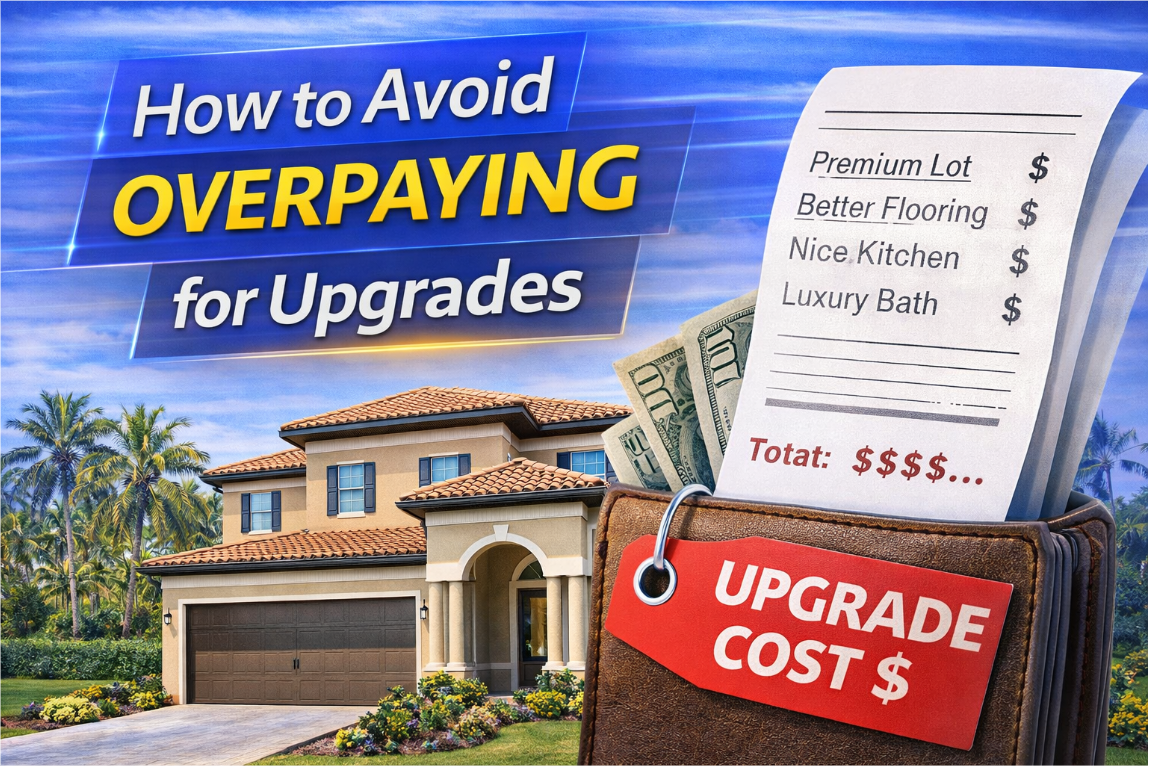
The model home looks beautiful — and it is supposed to. The cabinets are a step up. The counters are better. The lanai doors are wider. The lighting feels elevated and intentional. And before long, buyers who started with a clear budget are sitting at a design center number that is $30,000, $50,000, or more above where they planned to be.
Consumer guidance on new construction costs consistently flags upgrade fees as one of the most commonly underestimated expenses in the buying process. That does not mean upgrades are a bad idea. It means buyers need to be far more deliberate about which upgrades genuinely improve daily life, long-term function, or future resale — and which ones mainly make the model feel more emotionally compelling in the moment.
If you are buying new construction in Sarasota, Lakewood Ranch, Venice, Nokomis, or nearby areas, here is how to approach upgrades so you end up with a home that feels well-chosen — not one that felt exciting at signing but expensive ever since.
Why Upgrade Overspending Happens So Easily
Builders are not just selling a floor plan. They are selling a finished vision of how your life could look.
That is the entire purpose of the model home — to help buyers picture the lifestyle. And it works. The problem is that it can also blur the line between what is included in the base price and what costs extra, in ways that are easy to miss in the moment.
The CFPB says buyers should decide what they want to spend before shopping and compare the impact of higher-priced choices on their total monthly payment — not just evaluate each item individually as it comes up.
In practice, upgrade overspending tends to happen because buyers:
- Assume the model home reflects a realistic version of the standard home
- Make individual decisions without tracking the running total
- Treat each “small add-on” as inconsequential while ignoring the cumulative number
- Forget that upgrades affect both the purchase price and the monthly payment
- Choose emotionally appealing finishes that do not add meaningful long-term value
Set Your Upgrade Budget Before You Walk Into the Design Center
This is the most important step — and the one most buyers skip.
Before you select a single upgrade, decide what total price and total monthly payment still feel genuinely comfortable. The CFPB recommends that buyers work from a realistic housing budget and evaluate how higher-priced choices affect total affordability — not just the headline number.
That means your upgrade budget should be a specific, pre-determined number — not a vague sense of “I’ll see how it goes.”
A useful structure looks like this:
- Ideal upgrade budget: what you would prefer to stay within
- Maximum upgrade budget: the highest number that still works comfortably with your full monthly cost
- No-go line: the point at which the home stops making financial sense
Without that structure, the design center becomes a shopping experience instead of a financial decision. And it is designed to feel exactly like a shopping experience.
Separate Upgrades Into Two Categories: Hard to Change Later vs. Easy to Change Later
This is one of the most practical frameworks for making smarter upgrade decisions.
Hard or expensive to change after closing — worth stronger consideration:
- Structural changes and room additions
- Additional windows, sliders, or door configurations
- Extended lanais or covered outdoor living areas
- Higher ceilings or tray ceiling features
- Electrical and plumbing rough-ins for future additions
- Upgraded electrical placement for TVs, appliances, or outdoor use
- Garage expansions or layout changes
Easier to change after closing — apply more caution here:
- Decorative light fixtures and ceiling fans
- Cabinet hardware and pulls
- Mirrors and accent walls
- Some backsplash choices
- Certain paint colors and lower-impact finish decisions
The logic is straightforward: pay closer attention to upgrades that are invasive, structurally embedded, or genuinely expensive to redo after closing. Be more careful with items you can swap out later with minimal disruption.
Do Not Assume Builder Upgrade Pricing Is Always the Best Value
This is one of the quietest ways buyers overpay — and one of the least discussed.
Builder upgrades are convenient. You choose them, they roll into the loan, and they are done by the same team building the home. That convenience has real value.
But convenience and value are not the same thing. New construction cost guidance consistently identifies upgrade fees as an area where buyers routinely pay more than they would for comparable work done independently after closing.
The smarter question to ask at each decision point is not just: Do I want this upgrade?
It is: Is this upgrade worth doing through the builder right now — or is it better done after closing at a separate, potentially lower cost?
Some builder upgrades are genuinely well-priced. Others carry a significant markup for the convenience of including them in the purchase. Knowing the difference can save you real money.
Prioritize Upgrades That Improve How You Actually Live
The best upgrade decisions usually start with function — not aesthetics, not model-home emotion, and not a fear of the standard finishes looking plain.
Before approving any upgrade, ask:
- Will this make daily life meaningfully easier or more comfortable?
- Will I notice and use this every single day?
- Will I genuinely regret not doing it now?
- Does this improve storage, flow, or how I use the space?
Functional upgrades tend to hold up better over time. They are less likely to feel like impulse spending six months after move-in. And they are more likely to carry real value for future buyers as well.
Examples of functional upgrades that often earn their cost:
- Improved kitchen storage and pantry configuration
- Better electrical placement for how you actually use rooms
- An upgraded shower layout or bathroom flow
- A more practical laundry room setup
- An extended lanai if you genuinely plan to live outdoors in Sarasota’s climate
Be Honest With Yourself About Model-Driven Upgrade Decisions
Some upgrades sell well not because they improve function or long-term value — but because they look extraordinary in a model home under perfect lighting.
Be especially careful when your reasoning sounds like:
- “It looked amazing in the model”
- “The standard version will feel too plain”
- “It’s only a little more” — repeated multiple times
- “I don’t want to regret it later” — driven more by anxiety than by a real need
That last phrase deserves special attention. “It’s only a little more” is exactly how upgrade totals grow from a reasonable number to one that changes your monthly payment in ways you did not fully plan for. The CFPB specifically advises buyers to keep checking how increasing costs affect total affordability — not just to evaluate each choice in isolation.
Ask for a Written Standard-vs.-Upgraded Breakdown
This is a simple, practical step that immediately improves your decision-making.
Before you start choosing upgrades, ask the builder for a clear written breakdown of:
- What is genuinely standard in the home
- What is upgraded in the model and what each upgrade costs
- What is required versus truly optional
- What can still be changed or added after closing
Written clarity slows the process down in a healthy way. It helps you compare decisions rationally instead of responding emotionally to a beautiful presentation. And it frequently reveals that some things you assumed were standard are already included — while others you assumed were modest add-ons carry more significant costs than the model implied.
Convert Every Upgrade Decision Into a Monthly Payment Impact
Most buyers evaluate upgrades by total dollar amount. That is a start — but it is not the complete picture.
The CFPB recommends that buyers compare higher-priced choices based on how they affect total monthly payment and overall affordability. That matters because a collection of individual upgrade decisions that each seem manageable can together create a materially different monthly housing cost than you originally planned.
Before finalizing any set of upgrades, ask:
- What is the total upgrade amount I am agreeing to?
- How does that change my estimated monthly payment?
- How does it affect my cash to close?
- With all costs included — mortgage, taxes, HOA, insurance — am I still genuinely comfortable?
That full-payment lens catches budget problems that a total-price view can miss.
Do Not Use the Warranty Argument to Justify Every Upgrade
Some buyers convince themselves that having the builder do everything is the safer choice because of the warranty. There is a version of this logic that makes sense — but it should not become a blanket reason to over-upgrade.
The FTC says builder warranties on new homes generally offer limited coverage on workmanship and materials for specific components, and that coverage length varies by component. “New” and “fully covered” are not the same thing.
Warranty logic is a valid consideration for certain upgrades — particularly structural and embedded items. It is not a sound reason to add decorative finishes or personal-taste choices that simply felt compelling in the design center.
Watch for the Costs That Surround the Upgrade Decision
The upgrade price tag is not always the only cost to consider.
Higher upgrade totals can also affect:
- Your mortgage principal and total loan amount
- Your down payment allocation
- Your total cash needed to close
- Your property tax basis over time
- How much post-closing budget you have available
That last point matters more than most buyers realize. Many new construction buyers arrive after closing with less financial flexibility than they expected — because the design center consumed budget they were counting on for window treatments, landscaping additions, furniture, closet systems, and move-in expenses.
Hidden-cost guidance for new construction specifically warns buyers to plan for post-closing expenses rather than assuming the home is financially complete once upgrade decisions are made.
A Simple Three-Bucket System for Smarter Upgrade Decisions
If you want a clean, practical way to evaluate upgrades without getting overwhelmed, this works well:
Bucket 1 — Do Now Hard to change later, meaningfully affects daily function, or invasive to redo after closing. These deserve priority consideration if they fit the budget.
Bucket 2 — Nice to Have Worthwhile if the numbers still feel comfortable after Bucket 1 is settled. Do not start here.
Bucket 3 — Do Later or Skip Decorative, easy to do independently after closing, overpriced through the builder, or driven mainly by model-home emotion. These are where most buyers overspend.
This framework stops buyers from treating every upgrade as if it carries equal weight — because it does not.
One Question That Cuts Through Almost Every Upgrade Decision Before approving any upgrade, ask yourself:
Would I still choose this if I had to write a separate check for it after closing?
That question removes the psychological convenience of financing upgrades into the home price and forces an honest evaluation of whether you genuinely value the item enough to prioritize it.
If the answer is no — or if you hesitate — that is useful information.
The Goal Is Not to Skip Upgrades — It Is to Choose the Right Ones
A well-upgraded home in a Sarasota new construction community can be a genuinely better daily experience and a smarter long-term asset. The goal is not to come out of the design center with the cheapest possible package.
The goal is to avoid paying for upgrades that do not improve your life enough to justify what they cost.
The buyers who feel best about their Sarasota new construction purchase usually did three things consistently: they set a real upgrade budget before the design center, they focused first on functional and hard-to-change items, and they kept checking how every decision affected the full monthly cost of the home. That approach aligns directly with CFPB guidance to budget realistically and compare the impact of higher costs on total affordability.
If you do that, you are far more likely to end up with a home that feels like a smart, considered choice — rather than one that felt exciting at signing but stretched every month after.
Frequently Asked Questions
How do buyers typically overpay for upgrades in Sarasota new construction? Most upgrade overspending comes from making emotionally driven decisions in the design center, approving multiple small add-ons without tracking the cumulative total, and underestimating how upgrade fees affect the full monthly housing cost. Consumer guidance on new construction costs consistently identifies upgrade fees as one of the most commonly underestimated expenses in the process.
Which upgrades are usually worth doing through the builder? The strongest candidates are upgrades that are hard, invasive, or expensive to change after closing — structural changes, major electrical or plumbing modifications, extended lanais, and large layout-related features. These are worth stronger consideration precisely because doing them later typically costs significantly more and creates more disruption.
Should I do cosmetic upgrades through the builder? Not automatically. Cosmetic and decorative items are often the first category to slow down and scrutinize carefully. Builder pricing on these items can carry a meaningful markup, and many can be done after closing at lower cost and with more flexibility in vendor selection.
How do I keep upgrades from pushing my budget too far? Set a specific upgrade budget — with a hard ceiling — before the design center appointment. Ask for a written standard-vs.-upgraded breakdown from the builder. And convert every upgrade decision into a monthly payment impact, not just a total price figure. The CFPB recommends evaluating higher-cost choices based on their effect on total affordability, not just the sticker amount.
Do upgrades actually affect the monthly payment on a new construction home? Yes. Higher upgrade totals increase the total purchase price, which increases the loan amount and the monthly payment. The CFPB specifically recommends comparing upgrade choices based on how they affect total monthly affordability — not just evaluating them as individual line items.
Does the builder warranty make upgrades a better deal? Not by itself. The FTC notes that builder warranties generally offer limited coverage on workmanship and materials for specific components, and coverage length varies. Warranty coverage is a relevant consideration for certain structural or embedded upgrades — but it should not be used as a blanket justification for every design center decision.
What post-closing costs do buyers often forget to budget for? Common post-closing expenses that buyers underestimate include window treatments, landscaping additions, furniture, closet systems, move-in costs, and appliances in some communities. Planning for these before the design center — rather than after — helps buyers avoid arriving at closing with less financial flexibility than they expected.
About the Author
Tayna Vy is a trusted Realtor serving Sarasota and Lakewood Ranch, Florida. She specializes in new construction, luxury condos, lifestyle communities, probate, and helping clients navigate the process of buying and selling at the same time.
Buying a home, especially new construction, can feel frustrating when every builder has a different pitch and the real numbers are buried in the fine print.
Her Signature Home F.R.A.M.E.W.O.R.K. helps buyers cut through the builder noise and compare the true cost of ownership.
For sellers, her Signature Home M.A.G.N.E.T. process is built around targeted paid reach and smart marketing that attracts real buyers to get your house sold, not just open house foot traffic.
Tayna holds the ePRO, ABR®, SRS, and RENE designations and is a Certified Waterfront Specialist. She has been a real estate advisor for over 14 years as well as being awarded numerous Top Agent Awards with Specialized Real Estate. For her clients, that depth of experience means stronger negotiations, sharper representation, and an agent who genuinely understands the Sarasota-Manatee market.