Buying a new construction home can feel exciting and overwhelming at the same time.
You walk into a beautifully staged model home. The lighting is perfect. The finishes look polished. The kitchen feels high-end. The furniture fits the space so well that everything seems larger, cleaner, and easier to picture yourself in.
That is exactly what the model home is designed to do.
And that is where many buyers get off track.
The model home can help you understand a floor plan and imagine the lifestyle, but it should never be the only thing guiding your decision. In many cases, the home you tour includes upgrades, design features, and optional finishes that are not part of the base price. Federal consumer guidance also emphasizes looking carefully at the full cost of homeownership, loan details, and warranty coverage rather than relying on presentation alone.
If you want to make a smart decision, you need to compare new construction homes based on what you are really getting, what it will really cost, and how the home will actually function for your day-to-day life.
That means looking beyond the model home.
Why model homes can be misleading
There is nothing wrong with touring model homes. They are useful. But they are also marketing tools.
Builders use them to show the best possible version of the home. That often means premium flooring, upgraded cabinets, higher-level countertops, custom paint colors, feature walls, enhanced lighting, upgraded trim, and optional built-ins. A buyer may walk out assuming the advertised home price reflects what they just saw, when in reality the staged version may cost much more once all upgrades are added. Consumer guidance on new-home warranties also stresses that buyers should carefully review what is actually covered and what they are truly purchasing.
This is why one of the best mindset shifts is this:
Do not ask, “Do I love this model home?”
Ask, “How does this home compare once I remove the staging, decor, and upgrades?”
That is the question that leads to better decisions.
Start with the base home, not the finished fantasy
The first thing to compare is the actual starting point.
Before getting attached to the feel of the model, ask each builder for a written breakdown that shows:
- base price
- included features
- structural options
- lot premium
- design center upgrades
- estimated closing costs
- HOA fees
- CDD fees if applicable
The CFPB reminds buyers to account for more than the mortgage alone, including closing costs, taxes, insurance, and other ongoing ownership expenses. Its homebuying tools note that closing costs typically range from 2% to 5% of the purchase price, though actual costs vary by loan, property, and location.
This matters because one builder may advertise a lower price, but once you add the lot premium, required upgrades, and monthly fees, the final number may look very different.
Compare what is actually included
Two homes with similar square footage can offer very different value.
One builder may include impact glass, paver driveways, 42-inch cabinets, quartz counters, and smart home features in the base price. Another may treat most of those as upgrades.
That is why buyers should build a simple side-by-side list of standard features, including:
- flooring
- cabinets
- countertops
- appliances
- windows
- doors and trim
- ceiling heights
- garage features
- lanai finish
- landscaping
- smart home systems
The hidden-cost issue is real. Recent buyer guidance highlights that upgrade fees, lot premiums, HOA fees, landscaping, and other overlooked costs often add up faster than buyers expect.
A home with a higher base price may still be the better value if more of the features you want are already included.
Look at the floor plan through the lens of real life
A staged model is designed to feel open, attractive, and easy to love.
But the better question is whether the layout works for how you actually live.
Look closely at things like:
- kitchen storage
- pantry size
- bedroom dimensions
- furniture placement
- closet function
- bathroom layout
- natural light
- privacy between guest and primary spaces
- whether the home works as a long-term fit
This matters even more for buyers who are downsizing, relocating, or buying what they hope will be a long-term home. A layout can look beautiful in a model and still be frustrating in daily life if there is not enough storage, the guest rooms are too tight, or the den cannot realistically function as an office.
The model helps you imagine the dream. The floor plan has to support your actual routine.
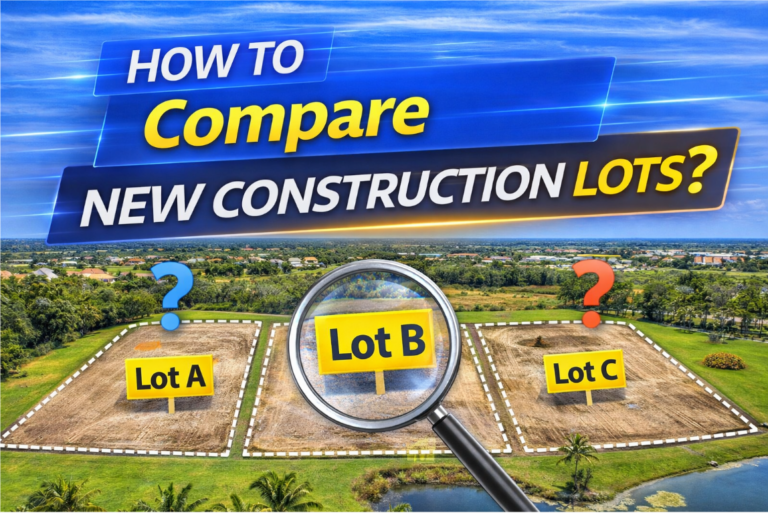
Compare lot quality, not just house quality
This is one of the most overlooked parts of buying new construction.
A model home is usually placed on a strong lot that shows well. It may have better spacing, a better view, or a better orientation than the lots still available for sale.
Two identical homes can feel completely different depending on the lot.
When comparing lots, ask:
- What does the backyard face?
- How close are neighboring lanais?
- Is there room for a pool?
- Will future construction change the view?
- Does the lot back to a road, retention pond, preserve, or another row of homes?
- Does the lanai get harsh west sun in the afternoon?
- Does the lot premium make sense for resale later?
A great floor plan on a weak lot can end up being a disappointing purchase.
Focus on monthly cost, not just purchase price
This is where many buyers get surprised.
The real cost of owning a new construction home includes much more than the contract price. The CFPB’s home loan toolkit reminds buyers that the monthly mortgage payment is only one part of what it costs to own a home and that taxes, insurance, utilities, and ongoing costs all matter.
When comparing homes, look at the full monthly picture:
- principal and interest
- property taxes
- homeowners insurance
- HOA dues
- CDD fees
- estimated utilities
- maintenance responsibilities
- cost of upgrades not included
- window treatments
- appliances not included
- landscaping or fencing if needed
This is especially important in Florida, where HOA costs are common in newer communities and can materially affect affordability. Recent reporting found HOA fees have become more common in single-family housing and can be a meaningful share of monthly ownership costs.
A home that looks affordable at the sales center can feel very different once the real monthly number is calculated.
Understand builder incentives clearly
Builder incentives can be helpful, but they should be compared carefully.
A builder may offer a lower interest rate, closing cost help, or design credits. That sounds great, and sometimes it really is a good deal. But recent reporting notes that these incentives are often tied to the builder’s preferred lender and can come with trade-offs that buyers need to evaluate carefully.
When looking at incentives, compare:
- the interest rate
- the APR
- whether the buydown is temporary or permanent
- total loan cost
- whether the home price already reflects the “incentive”
- whether comparable resale homes offer better value
Do not let the incentive distract you from the bigger question of whether the home is still the right financial fit.
Review the contract and warranty structure
New construction is not the same as resale.
Builders usually use their own contracts, their own timelines, their own change-order rules, and their own deposit schedules. The FTC advises buyers to understand what kind of warranty they are getting, what is covered, what is excluded, how claims work, and whether the warranty is backed by the builder or a third party.
That means you should understand:
- when deposits become nonrefundable
- what happens if construction is delayed
- what happens if materials or finishes change
- what punch-list process applies before closing
- how warranty service is handled after closing
- what is builder-backed versus third-party coverage
The model home will not explain that part. The paperwork does.
Compare the builder experience too
You are not just choosing a house. You are choosing a months-long process.
That is why the builder’s communication style matters.
Pay attention to:
- how clearly questions are answered
- whether upgrade pricing is transparent
- how organized the sales process feels
- how realistic their timeline sounds
- whether they explain what is included without being vague
- how they handle follow-up questions
A polished model home means very little if the process becomes frustrating, confusing, or full of surprises.
Tour inventory homes when possible
One of the best ways to compare beyond the model home is to tour inventory homes or homes already under construction.
These often give you a more realistic view of:
- actual room sizes
- standard finishes
- lot placement
- natural light
- how the home feels without perfect staging
- what the home looks like in real life, not just in presentation mode
The more you compare staged models against actual available homes, the easier it becomes to separate marketing from value.
Use a side-by-side comparison sheet
If you are comparing multiple homes or communities, make the process simple.
Use a chart with each home across the top and these items down the side:
- base price
- lot premium
- all-in estimated price
- HOA and CDD
- included features
- needed upgrades
- estimated monthly payment
- warranty structure
- lot quality
- location notes
- commute convenience
- resale appeal
- what you liked
- what gave you pause
That helps you make a decision based on facts instead of the emotional pull of whichever model looked the nicest.
The best question to ask after every model home tour
After every tour, ask yourself this:
Would I still want this home if it were empty, unstaged, and priced with all real costs included?
That question clears up a lot.
Because the goal is not to buy the prettiest model home.
The goal is to buy the right home, in the right community, with a clear understanding of what you are actually getting.
Final thoughts
Model homes are useful, but they should never be the whole decision.
The smartest buyers compare new construction homes based on included features, total cost, monthly payment, lot quality, builder incentives, warranty coverage, and how the home functions in real life. Federal consumer guidance supports exactly that kind of careful review, especially around costs, financing, and warranties.
When you compare new construction homes beyond the model home, you are much more likely to make a confident decision and much less likely to feel blindsided later.
FAQ: How to Compare New Construction Homes Beyond the Model Home
Why should buyers look beyond the model home?
Because model homes often include upgraded finishes, premium features, and staging that do not reflect the actual base home price or standard package. Buyers need to compare the real cost, included features, and lot quality, not just the presentation.
Are model home upgrades usually included in the price?
Not always. Many model homes showcase optional upgrades that can significantly raise the final price compared with the advertised base price. Buyers should request a full breakdown of standard versus upgraded features.
What should I compare when buying a new construction home?
Compare base price, included features, lot premium, HOA and CDD fees, estimated monthly cost, builder incentives, contract terms, warranty coverage, and how the layout works for your daily life.
Do builder incentives always save money?
Not necessarily. Builder incentives can help, but they are often tied to preferred lenders and should be compared using APR, total loan cost, and long-term affordability, not just the advertised rate.
Why does lot quality matter so much in new construction?
Because the same floor plan can feel very different depending on privacy, backyard view, sun exposure, distance from neighbors, and future construction around the lot. Lot quality can also affect resale later.
What hidden costs should new construction buyers watch for?
Common extra costs include lot premiums, design upgrades, HOA fees, landscaping, window treatments, appliances, closing costs, and ongoing ownership expenses beyond the mortgage.
Are new construction warranties all the same?
No. The FTC advises buyers to review who backs the warranty, what is covered, how long coverage lasts, what exclusions apply, and how claims must be made.
About the Author
Tayna Vy is a trusted Realtor serving Sarasota and Lakewood Ranch, Florida. She specializes in new construction, luxury condos, lifestyle communities, probate, and helping clients navigate the process of buying and selling at the same time.
Buying a home, especially new construction, can feel frustrating when every builder has a different pitch and the real numbers are buried in the fine print.
Her Signature Home F.R.A.M.E.W.O.R.K. helps buyers cut through the builder noise and compare the true cost of ownership.
For sellers, her Signature Home M.A.G.N.E.T. process is built around targeted paid reach and smart marketing that attracts real buyers to get your house sold, not just open house foot traffic.
Tayna holds the ePRO, ABR®, SRS, and RENE designations and is a Certified Waterfront Specialist. She has been a real estate advisor for over 14 years as well as being awarded numerous Top Agent Awards with Specialized Real Estate. For her clients, that depth of experience means stronger negotiations, sharper representation, and an agent who genuinely understands the Sarasota-Manatee market.